
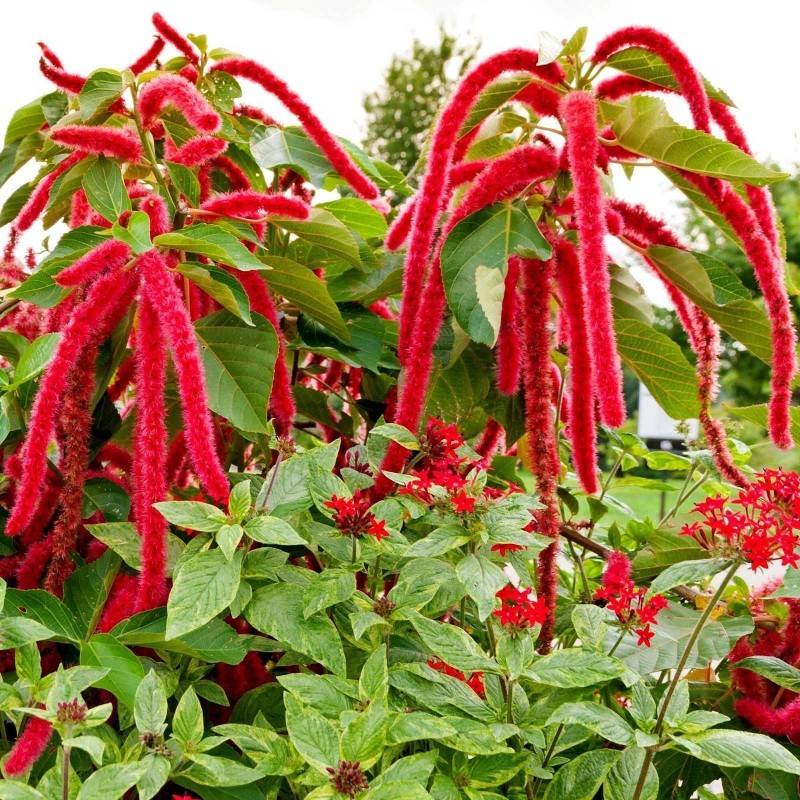
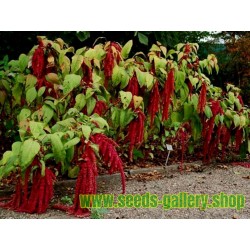
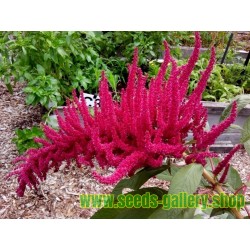
Amaranthus, collectively known as amaranth, is a cosmopolitan genus of annual or short-lived perennial plants. Some amaranth species are cultivated as leaf vegetables, cereals, and ornamental plants. Most of the species from Amaranthus are summer annual weeds and are commonly referred to as pigweed. Catkin-like cymes of densely packed flowers grow in summer or autumn.
Approximately 60 species are recognized, with inflorescences and foliage ranging from purple and red to green or gold. Members of this genus share many characteristics and uses with members of the closely related genus Celosia.
"Amaranth" derives from Greek ἀμάραντος (amarantos), "unfading," with the Greek word for "flower," ἄνθος (anthos), factoring into the word's development as "amaranth." The more accurate "amarant" is an archaic variant.
Taxonomy
Amaranthus shows a wide variety of morphological diversity among and even within certain species. Although the family (Amaranthaceae) is distinctive, the genus has few distinguishing characters among the 70 species included. This complicates taxonomy and Amaranthus has generally been considered among systematists as a "difficult" genus.
Formerly, Sauer (1955) classified the genus into two subgenera, differentiating only between monoecious and dioecious species: Acnida (L.) Aellen ex K.R. Robertson and Amaranthus.
Although this classification was widely accepted, further infrageneric classification was (and still is) needed to differentiate this widely diverse group.
Currently, Amaranthus includes three recognized subgenera and 70 species, although species numbers are questionable due to hybridization and species concepts. Infrageneric classification focuses on inflorescence, flower characters and whether a species is monoecious/dioecious, as in the Sauer (1955) suggested classification. A modified infrageneric classification of Amaranthus was published by Mosyakin & Robertson (1996) and includes three subgenera: Acnida, Amaranthus, and Albersia. The taxonomy is further differentiated by sections within each of the subgenera.
Human uses
History
Known to the Aztecs as huauhtli, it is thought to have represented up to 80% of their caloric consumption before the conquest. Another important use of amaranth throughout Mesoamerica was to prepare ritual drinks and foods. To this day, amaranth grains are toasted much like popcorn and mixed with honey, molasses or chocolate to make a treat called alegría, meaning "joy" in Spanish. Diego Duran described the festivities for Huitzilopochtli, whose name means "hummingbird of the left side" or "left-handed hummingbird". (Real hummingbirds feed on amaranth flowers.) The Aztec month of Panquetzaliztli (7 December to 26 December) was dedicated to Huitzilopochtli. People decorated their homes and trees with paper flags; there were ritual races, processions, dances, songs, prayers, and finally human sacrifices. This was one of the more important Aztec festivals, and the people prepared for the whole month. They fasted or ate very little; a statue of the god was made out of amaranth (huautli) seeds and honey, and at the end of the month, it was cut into small pieces so everybody could eat a little piece of the god. After the Spanish conquest, cultivation of amaranth was outlawed, while some of the festivities were subsumed into the Christmas celebration.
Because of its importance as a symbol of indigenous culture, its gluten-free palatability, ease of cooking, and a protein that is particularly well-suited to human nutritional needs, interest in grain amaranth (especially A. cruentus and A. hypochondriacus) revived in the 1970s. It was recovered in Mexico from wild varieties and is now commercially cultivated. It is a popular snack sold in Mexico, sometimes mixed with chocolate or puffed rice, and its use has spread to Europe and parts of North America. Amaranth and quinoa are non-grasses and are called pseudocereals because of their flavor and cooking similarities to cereals.
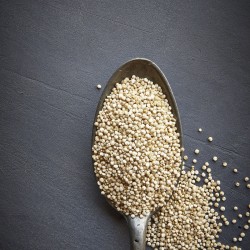
Amaranth seed
Several species are raised for amaranth "grain" in Asia and the Americas.
Ancient amaranth grains still used to this day include the three species, Amaranthus caudatus, Amaranthus cruentus, and Amaranthus hypochondriacus.[10] Although amaranth was cultivated on a large scale in ancient Mexico, Guatemala, and Peru, nowadays it is only cultivated on a small scale there, along with India, China, Nepal, and other tropical countries; thus, there is potential for further cultivation in those countries, as well as in the U.S. In a 1977 article in Science, amaranth was described as "the crop of the future." It has been proposed as an inexpensive native crop that could be cultivated by indigenous people in rural areas for several reasons:
It is easily harvested.
Its seeds are a good source of protein. Compared to grains, amaranth is unusually rich in the essential amino acid lysine. Common grains such as wheat and corn are comparatively rich in amino acids that amaranth lacks; thus, amaranth and grains can complement each other.
The seeds of Amaranthus species contain about thirty percent more protein than cereals like rice, sorghum and rye. In cooked and edible forms, amaranth is competitive with wheat germ and oats - higher in some nutrients, lower in others.
It is easy to cook.
As befits its weedy life history, amaranth grains grow very rapidly and their large seedheads can weigh up to 1 kilogram and contain a half-million seeds in three species of amaranth.
Amaranth seed flour
Amaranth seed flour has been evaluated as an additive to wheat flour by food specialists. To determine palatability, different levels of amaranth grain flour were mixed with the wheat flour and baking ingredients (1% salt, 2.5% fat, 1.5% yeast, 10% sugar and 52–74% water), fermented, molded, pan-proofed and baked. The baked products were evaluated for loaf volume, moisture content, color, odor, taste and texture. The amaranth containing products were then compared with bread made from 100% wheat flour. The loaf volume decreased by 40% and the moisture content increased from 22 to 42% with increase in amaranth grain flour. The study found that the sensory scores of the taste, odor, color, and texture decreased with increasing amounts of amaranth. Generally, above 15% amaranth grain flour, there were significant differences in the evaluated sensory qualities and the high amaranth-containing product was found to be of unacceptable palatability to the population sample that evaluated the baked products.
Leaves, roots, and stems
Amaranth species are cultivated and consumed as a leaf vegetable in many parts of the world. There are four species of Amaranthus documented as cultivated vegetables in eastern Asia: Amaranthus cruentus, Amaranthus blitum, Amaranthus dubius, and Amaranthus tricolor.
In Indonesia and Malaysia, leaf amaranth is called bayam. In the Philippines, the Ilocano word for the plant is "kalunay"; the Tagalog word for the plant is kilitis or "kulitis". In the state of Uttar Pradesh and Bihar in India, it is called Chaulai and is a popular green leafy vegetable (referred to in the class of vegetable preparations called saag). It is called Chua in Kumaun area of Uttarakhand, where it is a popular red-green vegetable. In Karnataka state in India, it is called Harive (ಹರಿವೆ). It is used to prepare curries like Hulee, palya, Majjigay-hulee and so on. In the state of Kerala, it is called 'Cheera' and is consumed by stir-frying the leaves with spices and red chillies to make 'Cheera Thoran'. In Tamil Nadu State, it is called முளைக்கீரை and is regularly consumed as a favourite dish, where the greens are steamed, and mashed, with light seasoning of salt, red chillis and cumin. It is called keerai masial (கீரை மசியல்). In Andhra Pradesh this leaf is added in preparation of a popular dal called thotakura pappu తొట కూర పప్పు (Telugu). In Maharashtra, it is called "Shravani Maath" (literally माठ grown in month of Shravan) and it is available in both red and white colour. In Orissa, it is called "Khada saga", it is used to prepare 'Saga Bhaja', in which the leaf is fried with chillies and onions.
The root of mature amaranth is a popular vegetable. It is white and cooked with tomatoes or tamarind gravy. It has a milky taste and is alkaline.
In China, the leaves and stems are used as a stir-fry vegetable, or in soups, and called 苋菜 (Mandarin Pinyin: xiàncài; Cantonese Jyutping: jin6 coi3) with variations in various dialects). Amaranth greens are believed to help enhance eyesight.[citation needed] In Vietnam, it is called rau dền and is used to make soup. There are two species popular as edible vegetable in Vietnam: dền đỏ- amaranthus tricolor and dền cơm or dền trắng- amaranthus viridis.
A traditional food plant in Africa, amaranth has the potential to improve nutrition, boost food security, foster rural development and support sustainable land care.[19] In East Africa, amaranth leaf is known in chewa as bonongwe, and in Swahili as mchicha, as terere in Kikuyu, Meru and Embu; and as telele in Kamba. In Bantu regions of Uganda it is known as doodo.[20] It is recommended by some doctors for people having low red blood cell count. It is also known among the Kalenjin as a drought crop (chepkerta). In Lingala (spoken in the Congo), it is known as lɛngalɛnga or bítɛkutɛku.[21] In Nigeria, it is a common vegetable and goes with all Nigerian starch dishes. It is known in Yoruba as Shoko a short form of Shokoyokoto (meaning make the husband fat) or arowo jeja (meaning "we have money left over for fish"). In the Caribbean, the leaves are called bhaji in Trinidad and callaloo in Jamaica, and are sautéed with onions, garlic and tomatoes, or sometimes used in a soup called pepperpot soup.
In Greece, green amaranth (Amaranthus viridis) is a popular dish and is called βλήτα, vlita or vleeta. It is boiled, then served with olive oil and lemon juice like a salad, sometimes alongside fried fish. Greeks stop harvesting the plant (which also grows wild) when it starts to bloom at the end of August.
In Sri Lanka, it is called "koora thampala". Sri Lankans cook it and eat it with rice. Fiji Indians call it choraiya bhaji.
Dyes
The flowers of the 'Hopi Red Dye' amaranth were used by the Hopi (a tribe in the western United States) as the source of a deep red dye. There is also a synthetic dye that has been named "amaranth" for its similarity in color to the natural amaranth pigments known as betalains. This synthetic dye is also known as Red No. 2 in North America and E123 in the European Union.
Ornamentals
The genus also contains several well-known ornamental plants, such as Amaranthus caudatus (love-lies-bleeding), a native of India and a vigorous, hardy annual with dark purplish flowers crowded in handsome drooping spikes. Another Indian annual, A. hypochondriacus (prince's feather), has deeply veined lance-shaped leaves, purple on the under face, and deep crimson flowers densely packed on erect spikes.
Amaranths are recorded as food plants for some Lepidoptera (butterfly and moth) species including the nutmeg moth and various case-bearer moths of the genus Coleophora: C. amaranthella, C. enchorda (feeds exclusively on Amaranthus), C. immortalis (feeds exclusively on Amaranthus), C. lineapulvella and C. versurella (recorded on A. spinosus).
Nutritional value
Amaranth greens are a common leaf vegetable throughout the tropics and in many warm temperate regions. See Callaloo
Cooked amaranth leaves are a good source of vitamin A, vitamin C, and folate; they are also a complementing source of other vitamins such as thiamine, niacin, and riboflavin, plus some dietary minerals including calcium, iron, potassium, zinc, copper, and manganese. Cooked amaranth grains are a complementing source of thiamine, niacin, riboflavin, and folate, and dietary minerals including calcium, iron, magnesium, phosphorus, zinc, copper, and manganese - comparable to common grains such as wheat germ, oats and others.
Amaranth seeds contain lysine, an essential amino acid, limited in grains or other plant sources.
Most fruits and vegetables do not contain a complete set of amino acids, and thus different sources of protein must be used. Amaranth too is limited in some essential amino acids, such as leucine and threonine. Amaranth seeds are therefore a promising complement to common grains such as wheat germ, oats, and corn because these common grains are abundant sources of essential amino acids found to be limited in amaranth.
Amaranth may be a promising source of protein to those who are gluten sensitive, because unlike the protein found in grains such as wheat and rye, its protein does not contain gluten. According to a 2007 report, amaranth compares well in nutrient content with gluten-free vegetarian options such as buckwheat, corn, millet, wild rice, oats and quinoa.
Several studies have shown that like oats, amaranth seed or oil may be of benefit for those with hypertension and cardiovascular disease; regular consumption reduces blood pressure and cholesterol levels, while improving antioxidant status and some immune parameters.
While the active ingredient in oats appears to be water-soluble fiber, amaranth appears to lower cholesterol via its content of plant stanols and squalene.
Amaranth remains an active area of scientific research for both human nutritional needs and foraging applications. Over 100 scientific studies suggest a somewhat conflicting picture on possible anti-nutritional and toxic factors in amaranth, more so in some particular strains of amaranth. Lehmann, in a review article, identifies some of these reported anti-nutritional factors in amaranth to be phenolics, saponins, tannins, phytic acid, oxalates, protease inhibitors, nitrates, polyphenols and phytohemagglutinins. Of these, oxalates and nitrates are of more concern when amaranth grain is used in foraging applications. Some studies suggest thermal processing of amaranth, particularly in moist environment, prior to its preparation in food and human consumption may be a promising way to reduce the adverse effects of amaranth's anti-nutritional and toxic factors.
Ecology
Amaranth weed species have an extended period of germination, rapid growth, and high rates of seed production, and have been causing problems for farmers since the mid-1990s. This is partially due to the reduction in tillage, reduction in herbicidal use and the evolution of herbicidal resistance in several species where herbicides have been applied more often.[35] The following 9 species of Amaranthus are considered invasive and noxious weeds in the U.S and Canada: A. albus, A. blitoides, A. hybridus, A. palmeri, A. powellii, A. retroflexus, A. spinosus, A. tuberculatus, and A. viridis.
A new herbicide-resistant strain of Amaranthus palmeri has appeared; it is glyphosate-resistant and so cannot be killed by herbicides using the chemical. Also, this plant can survive in tough conditions.This could be of particular concern to cotton farmers using glyphosate-resistant cotton. The species Amaranthus palmeri (Palmer amaranth) causes the greatest reduction in soybean yields and has the potential to reduce yields by 17-68% in field experiments. Palmer amaranth is among the "top five most troublesome weeds" in the southeast of the United States and has already evolved resistances to dinitroaniline herbicides and acetolactate synthase inhibitors. This makes the proper identification of Amaranthus species at the seedling stage essential for agriculturalists. Proper weed control needs to be applied before the species successfully colonizes in the crop field and causes significant yield reductions.
Seed saving
There are a multitude of varieties which cross with one another very easily. Some species have been found to cross with one another e.g. Amaranthus caudatus and Amaranthus hypochondriacus. For most types, flowering occurs as the days become shorter.
Being wind-pollinated, they will cross with one another if less than 400 metres apart at flowering time. If the seed is to be used for planting, roguing is necessary to remove inferior individuals before they can flower and pollinate better plants.
The seed heads mature gradually from bottom to top, requiring harvesters to be selective when choosing plants for seed harvesting. Seed harvest is maximized by shaking the near-mature seed heads into a paper bag or onto a canvas. In large growing areas the heads are cut all at once when most of the seeds are ripe. Once the heads have fully ripened, they tend to drop their seeds, so harvesting is done just before this point.
Heads are then dried for a week and threshed with gloved hands or feet on canvas as the chaff is somewhat prickly. Care is required not to lose the seeds when winnowing because the chaff and seeds are of similar size and the seeds are of a light weight. Heaping uncleaned seeds in a bowl and tossing them will concentrate the light debris on the top, and it can then blow away. The process is repeated until only seeds remain.
Parametry
 Reviews (0)