

Plant bestand tegen kou en vorst
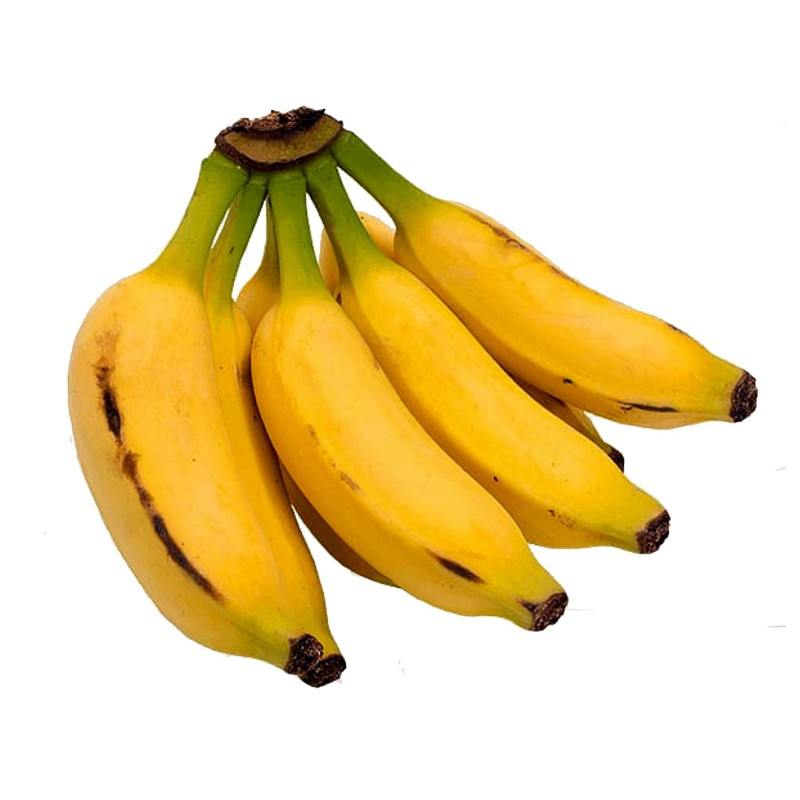
De koude-tolerante bananenplant die winterhard is tot zone 8 De babybanaan, rijstbanaan of Pisang susu zijn synoniemen voor het bananenras Lady Finger
De koude-tolerante bananenplant die winterhard is tot zone 8
De babybanaan, rijstbanaan of Pisang susu zijn synoniemen voor het bananenras Lady Finger. Lady Finger behoort tot het geslacht Musa en heeft het genoomtype AAB. De babybanaan is oorspronkelijk afkomstig uit de Andes van Colombia.
De babybanaan wordt geteeld in onder andere Kenia, Thailand, Mexico en Colombia en daar gebruikt als kookbanaan.
Het is een kleine (6 tot 8 cm lange) banaan met een erg zoete, vanille-achtige smaak, terwijl de gewone dessertbanaan ongeveer 20 cm is. De schil is dun en in rijpe toestand geel.
Musa acuminata is a species of banana native to Southeast Asia. Most of the modern edible dessert bananas belong to this species, although some are hybrids with Musa balbisiana. First cultivated by humans at around 8000 BC is one of the early examples of domesticated plants.
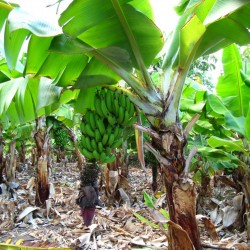
Musa acuminata is an evergreen perennial, not a tree. The trunk (known as the pseudostem) is made of tightly packed layers of leaf sheaths emerging from completely or partially buried corms.
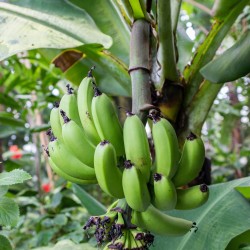
The inflorescence grows horizontally or obliquely from the trunk. The individual flowers are white to yellowish-white in color and are negatively geotropic (that is, growing upwards and away from the ground). Both male and female flowers are present in a single inflorescence. Female flowers located near the base (and develop into fruit), and the male flowers located at the topmost top-shaped bud in between leathery bracts.
The rather slender fruits are berries, the size of each depends on the number of seeds they contain. Each fruit can have 15 to 62 seeds. Each fruit bunch can have an average of 161.76 ± 60.62 fingers with each finger around 2.4 cm (0.94 in) by 9 cm (3.5 in) in size.
The seeds of wild Musa acuminata are around 5 to 6 mm (0.20 to 0.24 in) in diameter. They are subglobose or angular in shape and very hard. The tiny embryo is located at the end of the micropyle. Each seed of Musa acuminata typically produces around four times its size in edible starchy pulp (the parenchyma, the portion of the bananas eaten), around 0.23 cm3 (0.014 cu in). Wild Musa acuminata is diploid with 2n=2x=22 chromosomes, while cultivated varieties (cultivars) are mostly triploid (2n=3x=33) and parthenocarpic, producing fruit without seeds. The most familiar dessert banana cultivars belong to the Cavendish subgroup. The ratio of pulp to seeds increases dramatically in "seedless" edible cultivars: the small and largely sterile seeds are now surrounded by 23 times their size inedible pulp. The seeds themselves are reduced to tiny black specks along the central axis of the fruit.
Taxonomy
Musa acuminata belongs to section Musa (formerly Eumusa) of the genus Musa. It belongs to the family Musaceae of the order Zingiberales. It is divided into several subspecies (see the section below).
Musa acuminata was first described by the Italian botanist Luigi Aloysius Colla in the book Memorie della Reale Accademia delle Scienze di Torino (1820). Although other authorities have published various names for this species and its hybrids mistaken for different species (notably Musa sapientum by Linnaeus which is now known to be a hybrid of Musa acuminata and Musa balbisiana), Colla's publication is the oldest name for the species and thus has precedence over the others from the rules of the International Code of Botanical Nomenclature. Colla also was the first authority to recognize that both Musa acuminata and Musa balbisiana were wild ancestral species, even though the specimen he described as a naturally occurring seedless polyploid like cultivated bananas.
Distribution
Musa acuminata is native to the biogeographical region of Malesia and most of mainland Indochina.
Musa acuminata favors wet tropical climates in contrast to the hardier Musa balbisiana, the species it hybridized extensively with to provide almost all modern cultivars of edible bananas.[16] Subsequent spread of the species outside of its native region is thought to be purely the result of human intervention. Early farmers introduced M. acuminata into the native range of M. balbisiana resulting in hybridization and the development of modern edible clones.
AAB cultivars were spread from somewhere around the Philippines 4000 years ago and resulted in the distinct banana cultivars known as the Maia Maoli or Popoulo group bananas in the Pacific islands. They may have been introduced as well to South America during Precolumbian times from contact with early Polynesian sailors, although evidence of this is debatable.
Westward spread included Africa which already had evidence of Musa acuminata × Musa balbisiana hybrid cultivation from as early as 1000 to 400 BC. They were probably introduced first to Madagascar from Indonesia.
From West Africa, they were introduced to the Canary islands by the Portuguese in the 16th century, and from there were introduced to Hispaniola (modern Haiti and the Dominican Republic) in 1516.
Ecology
Musa acuminata is propagated sexually by seeds or asexually by suckers in the wild. Edible parthenocarpic cultivars are usually cultivated by suckers in plantations or cloned by tissue culture. Seeds are also still used in research for developing new cultivars.
Musa acuminata is a pioneer species. It rapidly exploits newly disturbed areas, like areas recently subjected to forest fires. It is also considered a 'keystone species' in certain ecosystems, paving the way for greater wildlife diversity once they have established themselves in an area. It is particularly important as a food source for wildlife due to its rapid regeneration.
Musa acuminata bears flowers that by their very structure, make it difficult to self-pollinate. It takes about four months for the flowers to develop in the fruits, with the fruit clusters at the bases ripening sooner than those at the tip.
A large variety of wildlife feeds on the fruits. These include frugivorous bats, birds, squirrels, tree shrews, civets, rats, mice, monkeys, and apes. These animals are also important for seed dispersal.
Mature seeds germinate readily 2 to 3 weeks after sowing. They can remain viable from a few months to two years of storage.
Domestication
In 1955, Norman Simmonds and Ken Shepherd revised the classification of modern edible bananas based on their genetic origins. Their classification depends on how many of the characteristics of the two ancestral species (Musa acuminata and Musa balbisiana) are exhibited by the cultivars. Most banana cultivars that exhibit purely or mostly Musa acuminata genomes are dessert bananas, while hybrids of M. acuminata and M. balbisiana are mostly cooking bananas or plantains.
Musa acuminata is one of the earliest plants to be domesticated by humans for agriculture. They were first domesticated in Southeast Asia and surrounding areas (possibly New Guinea, eastern Indonesia, and the Philippines) at around 8000 BC. It has been suggested that M. acuminata may have originally been domesticated for parts other than the fruit. Either for fiber, for construction materials, or for its edible male bud. They were selected early for parthenocarpy and seed sterility in their fruits, a process that might have taken thousands of years. This initially led to the first 'human-edible' banana diploid clones (modern AA cultivars). Diploid clones are still able to produce viable seeds when pollinated by wild species. This resulted in the development of triploid clones that were conserved for their larger fruit.
M. acuminata was later introduced into mainland Indochina into the range of another ancestral wild banana species - Musa balbisiana, a hardier species of lesser genetic diversity than M. acuminata. Hybridization between the two resulted in drought-resistant edible cultivars. Modern edible banana and plantain cultivars are derived from permutations of hybridization and polyploidy of the two.
Ornamental
M. acuminata is one of several banana species cultivated as an ornamental plant, for its striking shape and foliage. In temperate regions it requires protection from winter frosts. The cultivar M. acuminata (AAA Group) 'Dwarf Cavendish' has gained the Royal Horticultural Society's Award of Garden Merit.
Datasheet
 Beoordelingen (1)
 jean-joseph J op 17/09/2021
Graines Bananier Cavendish Nain
5 van 7 mensen vonden de volgende review behulpzaam
jean-joseph J op 17/09/2021
Graines Bananier Cavendish Nain
5 van 7 mensen vonden de volgende review behulpzaam
Livraison rapide et soignée
De koude-tolerante bananenplant die winterhard is tot zone 8 De babybanaan, rijstbanaan of Pisang susu zijn synoniemen voor het bananenras Lady Finger