

Plant bestand tegen kou en vorst
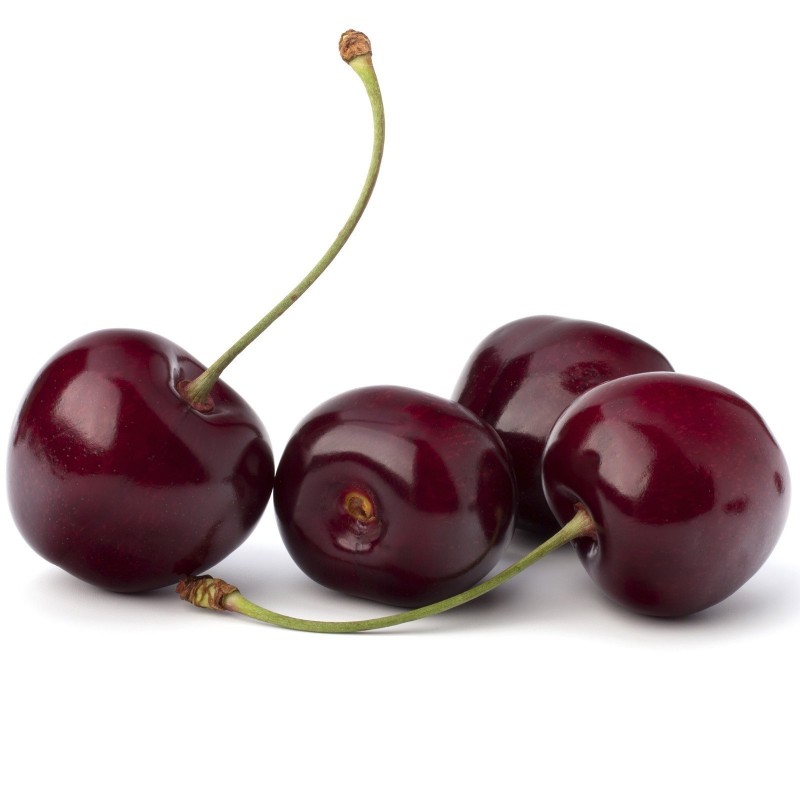
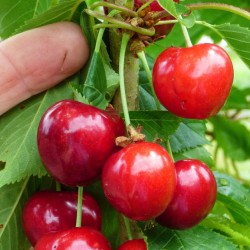
Prunus avium, commonly called wild cherry, sweet cherry, bird cherry, or gean, is a species of cherry native to Europe, western Turkey, northwestern Africa, and western Asia, from the British Isles south to Morocco
Prunus avium, commonly called wild cherry, sweet cherry, bird cherry, or gean, is a species of cherry native to Europe, western Turkey, northwestern Africa, and western Asia, from the British Isles south to Morocco and Tunisia, north to the Trondheimsfjord region in Norway and east to the Caucasus and northern Iran, with a small disjunct population in the western Himalaya.[3][4] This species, in the rose family (Rosaceae), has a diploid set of sixteen chromosomes (2n=16).[5] All parts of the plant except for the ripe fruit are slightly toxic, containing cyanogenic glycosides.
Nomenclature
The early history of its classification is somewhat confused. In the first edition of Species Plantarum (1753), Linnaeus treated it as only a variety, Prunus cerasus var. avium, citing Gaspard Bauhin's Pinax theatri botanici (1596) as a synonym;[clarification needed] his description, Cerasus racemosa hortensis ("Cherry with racemes, of gardens")[clarification needed] shows it was described from a cultivated plant.[6] Linnaeus then changed from a variety to a species Prunus avium in the second edition of his Flora Suecica in 1755.[7]
Sweet cherry was known historically as Gean or Mazzard (also 'massard'), until recently, both were largely obsolete names in modern English.
The name "wild cherry" is also commonly applied to other species of Prunus growing in their native habitats, particularly to the North American species Prunus serotina.
Prunus avium means "bird cherry" in the Latin language.[4] In English "bird cherry" often refers to Prunus padus.
Mazzard
More recently[when?] 'Mazzard' has been used to refer to a selected self-fertile cultivar that comes true from seed, and which is used as a seedling rootstock for fruiting cultivars.[9][10] This term is still used particularly for the varieties of P. avium grown in North Devon and cultivated there, particularly in the orchards at Landkey.
Description and ecology
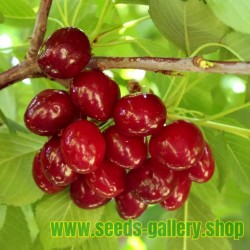
Prunus avium is a deciduous tree growing to 15–32 m (50-100 ft) tall, with a trunk up to 1.5 m (5 ft) in diameter. Young trees show strong apical dominance with a straight trunk and symmetrical conical crown, becoming rounded to irregular on old trees. The bark is smooth purplish-brown with prominent horizontal grey-brown lenticels on young trees, becoming thick dark blackish-brown and fissured on old trees. The leaves are alternate, simple ovoid-acute, 7–14 cm (3–6 in) long and 4–7 cm (2–3 in) broad, glabrous matt or sub-shiny green above, variably finely downy beneath, with a serrated margin and an acuminate tip, with a green or reddish petiole 2–3.5 cm (0.8-1.4 in) long bearing two to five small red glands. The tip of each serrated edge of the leaves also bear small red glands.[11] In autumn, the leaves turn orange, pink or red before falling. The flowers are produced in early spring at the same time as the new leaves, borne in corymbs of two to six together, each flower pendent on a 2–5 cm (0.8-2 in) peduncle, 2.5–3.5 cm (1-1.4 in) in diameter, with five pure white petals, yellowish stamens, and a superior ovary; they are hermaphroditic, and pollinated by bees. The fruit is a drupe 1–2 cm (0.4-0.8 in) in diameter (larger in some cultivated selections), bright red to dark purple when mature in midsummer, edible, variably sweet to somewhat astringent and bitter to eat fresh. Each fruit contains a single hard-shelled stone 8–12 mm long, 7–10 mm wide and 6–8 mm thick, grooved along the flattest edge; the seed (kernel) inside the stone is 6–8 mm long.
The fruit are readily eaten by numerous kinds of birds and mammals, which digest the fruit flesh and disperse the seeds in their droppings. Some rodents, and a few birds (notably the Hawfinch), also crack open the stones to eat the kernel inside. All parts of the plant except for the ripe fruit are slightly toxic, containing cyanogenic glycosides.
See also List of Lepidoptera that feed on Prunus
The leaves provide food for some animals, including Lepidoptera such as the case-bearer moth Coleophora anatipennella.
The tree exudes a gum from wounds in the bark, by which it seals the wounds to exclude insects and fungal infections.
Fruit
Some eighteenth and nineteenth century botanical authors[who?] assumed a western Asia origin for the species based on the writings of Pliny; however, archaeological finds of seeds from prehistoric Europe contradict this view. Wild cherries have been an item of human food for several thousands of years. The stones have been found in deposits at Bronze Age settlements throughout Europe, including in Britain.[9] In one dated example, wild cherry macrofossils were found in a core sample from the detritus beneath a dwelling at an Early and Middle Bronze Age pile-dwelling site on and in the shore of a former lake at Desenzano del Garda or Lonato, near the southern shore of Lake Garda, Italy. The date is estimated at Early Bronze Age IA, carbon dated there to 2077 BC plus or minus 10 years. The natural forest was largely cleared at that time.[16]
By 800 BC, cherries were being actively cultivated in Asia Minor, and soon after in Greece.[9]
As the main ancestor of the cultivated cherry, the sweet cherry is one of the two cherry species which supply most of the world's commercial cultivars of edible cherry (the other is the sour cherry Prunus cerasus, mainly used for cooking; a few other species have had a very small input).[9] Various cherry cultivars are now grown worldwide wherever the climate is suitable; the number of cultivars is now very large.[9] The species has also escaped from cultivation and become naturalised in some temperate regions, including southwestern Canada, Japan, New Zealand, and the northeast and northwest of the United States.
Ornamental
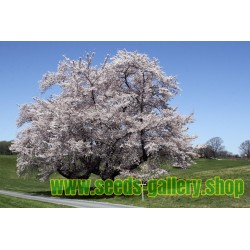
It is often cultivated as a flowering tree. Because of the size of the tree, it is often used in parkland, and less often as a street or garden tree. The double-flowered form, 'Plena', is commonly found, rather than the wild single-flowered forms.
Two interspecific hybrids, P. x schmittii (P. avium x P. canescens) and P. x fontenesiana (P. avium x P. mahaleb) are also grown as ornamental trees.
Timber
The hard, reddish-brown wood (cherry wood) is valued as a hardwood for woodturning, and making cabinets and musical instruments.[15] Cherry wood is also used for smoking foods, particularly meats, in North America, as it lends a distinct and pleasant flavor to the product.[citation needed]
Other uses
The gum from bark wounds is aromatic and can be chewed as a substitute for chewing gum.
Medicine can be prepared from the stalks of the drupes that is astringent, antitussive, and diuretic.
A green dye can also be prepared from the plant.
Contribution to other species
Prunus avium is thought to be one of the parent species of Prunus cerasus (sour cherry) by way of ancient crosses between it and Prunus fruticosa (dwarf cherry) in the areas where the two species overlap. All three species can breed with each other. Prunus cerasus is now a species in its own right having developed beyond a hybrid and stabilised.

Datasheet
 Beoordelingen (0)
Prunus avium, commonly called wild cherry, sweet cherry, bird cherry, or gean, is a species of cherry native to Europe, western Turkey, northwestern Africa, and western Asia, from the British Isles south to Morocco